

CASE STUDY
Chedoke Creek Remediation: Onsite Sediment Dewatering Reduces Hauling and Disposal Volume
Removing sediment from a creek is only part of the remediation challenge. Once dredged, the material must be contained, dewatered and prepared for removal, often within a constrained site and close to busy roads.
For the Chedoke Creek remediation project in Hamilton, Ontario, the City of Hamilton selected a team comprising Bishop Water, Milestone Environmental Contracting and Eco Technologies to hydraulically dredge sediment and manage the resulting slurry.
The Bishop Solids Management Solution (BSMS) provided onsite dewatering for nearly 140,000 m³ of slurried material. By separating water from the dredged sediment before hauling, the system significantly reduced the volume requiring removal and the number of trucks needed to transport it.
The challenge:
Manage large volumes of dredged sediment beside a busy highway
The project required the removal of thousands of tonnes of sediment from Chedoke Creek over several months in 2023.
Hydraulic dredging allowed sediment to be pumped out of the creek, but it also produced a large volume of slurry with a low solids concentration. Hauling that material without first removing water would have increased the volume requiring transport and disposal.
The project needed a dewatering approach that could accommodate high pumping rates, contain the sediment and released water, and reduce hauling requirements near a major highway.
The team established temporary dewatering cells on the opposite side of the highway from the creek. A pipeline stretching almost 400 metres connected the dredging operation to the dewatering site.
The solution:
Polymer conditioning and passive Geotube dewatering
Bishop Water deployed the BSMS, a low-energy system that combines Geotube® containers, polymer conditioning and passive, gravity-based dewatering.
Dredged slurry was pumped through an 8-inch line at rates of up to 4,000 L/min. Polymer was injected directly into the slurry line to bring fine particles together into larger flocs, helping retain solids inside the Geotubes and accelerate water release.
A manifold distributed the flow to multiple containers, allowing the dewatering system to accommodate the dredging operation’s high throughput.
In total, 11 Geotube containers were installed in lined dewatering cells. Each container measured 120 feet in circumference and 100 feet in length.
As water drained through the tightly woven polypropylene fabric, sediment remained contained within the Geotubes. This passive process produced dewatered solids that could be loaded into trucks for removal.
Process control
Adjusting polymer dosing to changing conditions
Effective dewatering required close attention to the characteristics of the incoming slurry.
Throughout pumping and dewatering, Bishop Water technicians collected samples several times each day from multiple points in the system. These samples helped the team optimize polymer dosing, flocculation and Geotube performance.
Flow and solids meters continuously monitored the feed and relayed information to control equipment in the polymer trailer. Polymer dosing was automatically adjusted according to the flow rate and the amount of solids entering the system.
Together, regular sampling and automated dosing supported the dewatering process as feed conditions changed.
Water management
Collecting and directing the filtrate
The lined dewatering cells contained the Geotubes and collected the water released during dewatering.
Polymer conditioning and Geotube filtration separated the sediment from the water, producing filtrate with low total suspended solids. For this project, the collected filtrate was directed to the city sewer.
This arrangement provided a managed route for the released water while keeping the dredged solids contained onsite.
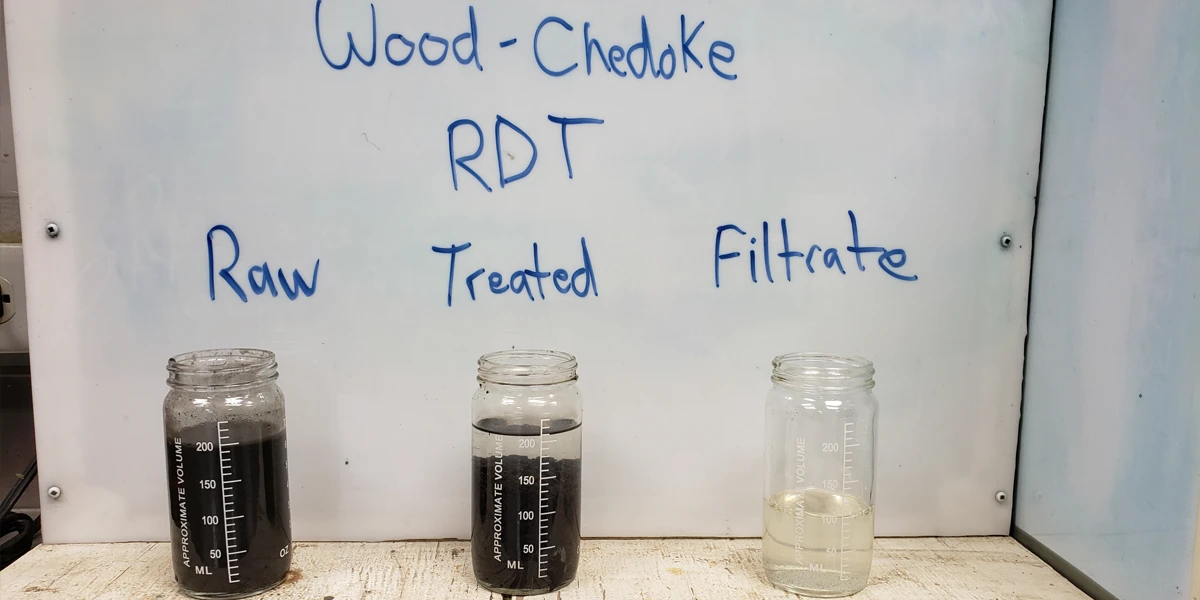
Jar testing illustrates the effectiveness of the polymer and Geotube filtration. From left, a sample of the untreated sediment; following polymer addition and floccculation the solids settle to the bottom of the jar; clear filtrate is shown after flocculated material is filtered through a cone fitted with a disc of Geotube fabric.
The results
Less material to haul and solids ready for removal
Nearly 140,000 m³ of slurried material was pumped to the Geotubes during the project, with a project-wide average incoming solids concentration of 2.85%.
The case study reports that solids concentrations increased to more than 70% after a few days of dewatering. Removing water onsite substantially reduced the material volume requiring transport, meaning fewer trucks were needed to remove the sediment.
The system also supported dredging rates of up to 4,000 L/min, enabling sediment removal to proceed efficiently.
Dredging was completed by mid-November 2023 after nearly four months of operation. The Geotubes remained onsite for several additional weeks to continue releasing water passively. By the end of 2023, all dewatered material had been removed from the site.
Planning a sediment dewatering project?
Chedoke Creek demonstrates how onsite dewatering can support large-scale remediation by reducing hauling volume, containing dredged sediment and managing released water.
Contact Bishop Water to discuss a solids management solution for your dredging or remediation project.


